Optovolution: Evolving Proteins with Light
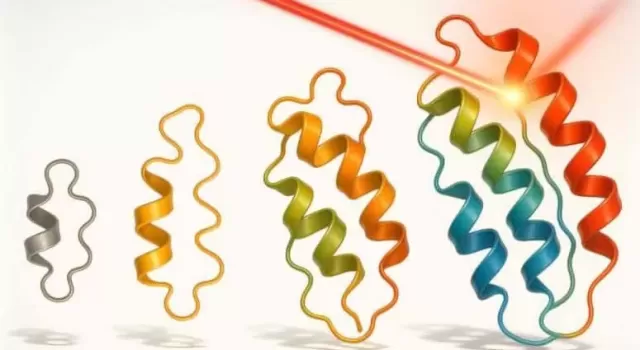
For centuries, humanity has guided the evolution of living systems, from selective breeding in agriculture to modern lab techniques that engineer proteins. This process, known as directed evolution, has revolutionized the creation of enzymes and antibodies for medicine and industry. Yet, a significant constraint has persisted: these methods typically favor proteins that are perpetually "on," which misses a fundamental truth of biology.
The Shortcoming of Static Selection
In nature, proteins are dynamic. They act as molecular switches, signal relays, and biological logic gates, toggling between active and inactive states in response to changing conditions. Traditional directed evolution, by applying constant selection pressure for a single state, can inadvertently degrade a protein's crucial ability to switch. This not only hampers the design of complex biological circuits but can also disrupt cellular function, sometimes with fatal results for the cell.
Introducing Optovolution: Evolution Guided by Light
A groundbreaking method developed by scientists at EPFL now bridges this gap. Dubbed "optovolution," this innovative approach uses pulses of light to direct the evolution of proteins within living yeast cells. It selects for dynamic function, rewarding proteins that can switch cleanly between states at precise moments, much like they would in a natural cellular environment.
The core of the system ingeniously links a protein's performance to cell survival. Researchers rewired the yeast cell cycle so that division depends on a protein correctly turning on and off. A mistimed or stuck signal proves toxic. By using optogenetics to deliver controlled light pulses, the team created a real-time test where each 90-minute cell cycle acts as a pass-or-fail checkpoint.
- Only cells with optimally switching proteins survive and reproduce.
- Poorly performing variants are automatically weeded out.
- This enables continuous, hands-off evolution of sophisticated protein behaviors.
Engineering Proteins with New Capabilities
Optovolution has already yielded remarkable results, generating novel protein variants with enhanced and unexpected functions:
- Improved Light Sensors: The team evolved new variants of a light-controlled transcription factor with greater sensitivity, lower background activity in darkness, and the rare ability to respond to green light—a color spectrum previously very challenging to engineer for.
- Simplified Systems: They adapted a red-light optogenetic system to function without an added chemical cofactor. Evolution cleverly disabled a native yeast transport protein, allowing the cell to harness its own internal molecules, streamlining the tool for broader research use.
- Single-Protein Computation: Perhaps most strikingly, the method evolved a transcription factor that operates as a basic biological computer. This protein activates genes only when it receives two simultaneous inputs—a specific light signal and a distinct chemical signal—acting as a precise molecular logic gate.
The Future of Dynamic Protein Design
This light-driven evolution technique opens new frontiers in synthetic biology and biotechnology. By mirroring the temporal complexity of real cells, optovolution provides a powerful platform to:
- Design advanced cellular circuits capable of sophisticated decision-making.
- Develop next-generation optogenetic tools responsive across the light spectrum.
- Fundamentally study how evolution crafts the dynamic protein behaviors essential for life, from environmental sensing to cell division control.
The ability to evolve proteins that operate not just as static tools but as dynamic, computing components brings us closer to engineering truly intelligent biological systems.