Tiny Arachnids Host Surprising New Parasitic Mite
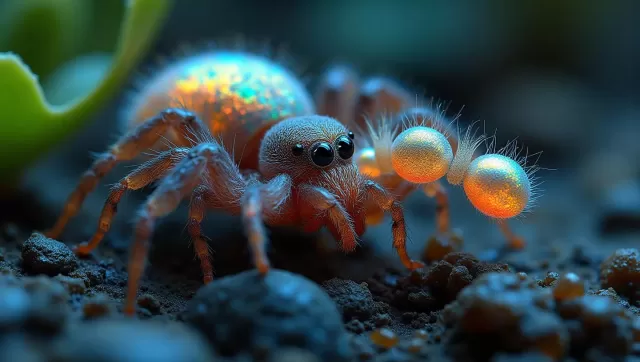
What appeared to be a tiny, shimmering pearl necklace draped around a spider's body has led to a significant breakthrough in Brazilian arachnology. While examining specimens at the Butantan Institute's Zoological Collections Laboratory in São Paulo, researchers spotted unusual bead-like structures on a spider measuring only a few millimeters. After consulting experts, the team identified these "pearls" as the larvae of a parasitic mite, marking only the second time such a relationship has been documented in Brazil.
A First for Brazil's Ecological Record
The discovery, detailed in the International Journal of Acarology, introduces a newly identified species named Araneothrombium brasiliensis. This find is particularly notable because it represents the first record of this specific family of mites in the country. Previously, the Araneothrombium genus had only been documented in Costa Rica, suggesting that these parasites are far more widespread across the neotropical landscape than scientists once believed.
To confirm the species, the research team utilized a combination of light microscopy and scanning electron techniques. Their findings highlighted several key aspects of the mite's existence:
- The larvae are microscopic, measuring roughly 500 micrometers (0.5 mm).
- They were found attached to juvenile spiders from three distinct families.
- All specimens were engorged, indicating they had successfully fed on their hosts.
- The species appears to be a "generalist" that may also target various insect orders.
The Strategic Anatomy of Parasitism
The biological interaction between Araneothrombium brasiliensis and its host is a masterclass in evolutionary opportunism. These mites feed on lymph, a vital fluid in arthropods, but they cannot pierce just any part of a spider's body. Most of a spider is covered in a thick, protective layer of chitin.
To bypass this armor, the mites latch onto the pedicel—the narrow "waist" that connects the spider's cephalothorax to its abdomen. This area is the spider's softest point, allowing the mite's fangs to penetrate with ease. Researchers noted that the mites specifically targeted juvenile spiders, likely because their exoskeletons are thinner and their defenses are less developed than those of adults.
From Parasite to Predator
One of the reasons this species remained hidden for so long is its complex life cycle. While the larval stage is parasitic and hitches a ride on spiders or insects, the adult form is entirely different. As they mature, these mites drop off their hosts and move into the soil, transitioning into free-living predators. In the dark recesses of the earth, they hunt small insects and other mites, making them incredibly difficult to track or collect in the wild.
The specimens that led to this discovery were originally collected in Pinheiral, Rio de Janeiro, an area known for its caves and rocky grottos. This environment mirrors the habitat where Brazil's first known spider-parasitic mite was discovered decades ago, hinting at a specialized ecosystem within these subterranean regions.
The Hidden Value of Zoological Collections
Perhaps the most significant takeaway from this discovery is the importance of "hidden biodiversity" within existing museum archives. The spiders used in this study had been preserved in the laboratory for years; the mites were there all along, hiding in plain sight until a keen eye noticed them.
With Brazil hosting more than 3,000 known spider species, experts believe this is only the beginning. By collaborating with field researchers and environmental consultants, the Butantan Institute aims to uncover more of these microscopic relationships, proving that even the smallest specimens in a glass jar can hold the keys to understanding a vast, complex ecosystem.